
Professional Embroidery Digitizing Services Across the USA
Production-Ready Digitizing Files. Trusted by 500+ embroidery shops.
From SoMa tech startups to LA Fashion District wholesalers, production shops rely on our files for one reason: they run clean. We deliver professional digitizing engineered for zero thread breaks and first-run success.
We don’t just trace pixels; we calculate pull compensation, optimize underlay structures, and engineer pathing for specific fabric types. Whether you need a 4-hour rush service or a 100-piece jacket back order, we guarantee 100% satisfaction.
Standard Size
$14.88Left-chest logos, polo shirts, caps.
Production optimized.
Portrait Size
$24.88Vertical designs, badges, detailed artwork.
Full Size
$59.88Jacket backs, large designs, event logos.
Our Core Production Services

Professional Embroidery Digitizing
Production-ready digitizing for contract embroiderers, promotional product distributors, and wholesale operations. Every file includes proper pull compensation, optimized underlay structure, and efficient stitch sequencing-ensuring clean runs on Tajima, Barudan, and Brother machines.
- Manual digitizing by experts (not auto-traced)
- Optimized for high-speed production
- Standard 5-6 hour turnaround

Vector Art Conversion Services
Transform pixelated logos into scalable vector files for embroidery, screen printing, and vinyl cutting. Essential for rebrands, low-resolution artwork, and multi-channel marketing campaigns. We manually redraw your artwork-no auto-trace shortcuts.
- Manual redrawing (not auto-trace)
- AI, EPS, SVG, PDF formats
- Perfect for screen printing prep

Color Separation for Screen Printing
Professional separations for spot color, CMYK, and simulated process printing. We generate halftones at your exact LPI, apply proper choke/spread trapping, and deliver print-ready files with registration marks-engineered for your mesh count and press setup.
- Spot, CMYK, Simulated Process
- Perfect underbase generation
- DCS 2.0 and layered PSD files

Custom Embroidered Patches
Production-ready patch digitizing with proper borders, tight stitch density, and optimal backing. Popular for corporate swag, promotional giveaways, uniform programs, and retail merchandise. We handle merrowed edge, hot-cut, and laser-cut specifications.
- Merrowed, hot-cut, laser-cut
- 100-10,000+ quantity runs
- Iron-on or sew-on backing
Digitizing Specialties We Offer

3D Puff Digitizing
We turn your design into raised, soft embroidery that stands out from the fabric. Perfect for team logos and sports gear.
Learn more about 3D Puff Digitizing
Applique Digitization
To save your time and thread, we create files that help stitch fabric pieces onto your items, making beautiful layered designs.
Learn more about Applique Digitization
Monograms & Lettering
We help put names, initials, and words on items using fancy or simple letter styles that stitch smoothly on any fabric.
Learn more about Monograms & Lettering
Chenille Digitizing
We also digitize files for fluffy, towel-like stitching that’s great for school letters, team badges, and warm winter wear.
Learn more about Chenille Digitizing
Patch Digitizing
Our digitizing experts turn artwork into files that make perfect patches with clean edges, ready to sew.
Learn more about Patch Digitizing
Left Chest Digitizing
We size and adjust logos to look just right when stitched on the left chest area of shirts and jackets.
Learn more about Left Chest Digitizing
Cap Digitizing
By working with the curved shape and small space, we make sure your design fits and looks great on caps.
Learn more about Cap Digitizing
Jacket Back Digitizing
We create large-scale designs that stitch beautifully across jacket backs, team names.
Learn more about Jacket Back DigitizingProduction Quality You Can Trust
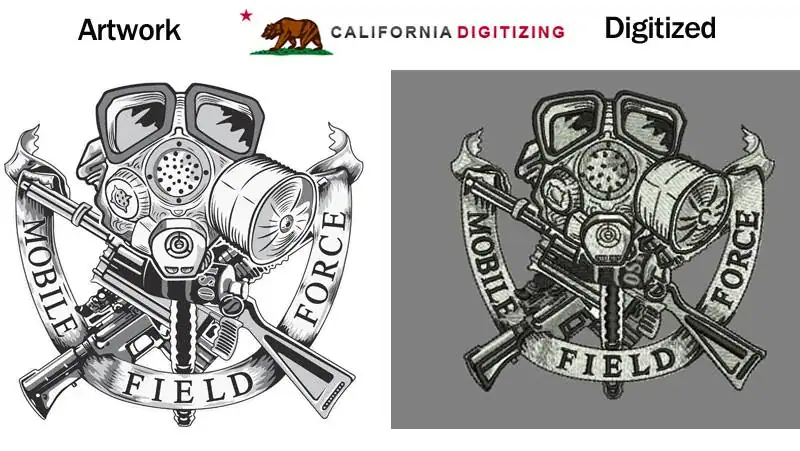
Browse our recent production files. From complex 3D puff to intricate jacket backs, our gallery showcases the precision we deliver daily.



Why Production Shops Trust Our Digitizing
Professional digitizing isn’t about converting images-it’s about engineering files that perform flawlessly on real production equipment. From pull compensation settings that prevent fabric distortion to underlay structures that stabilize stretchy knits, every decision affects your bottom line. Here’s what separates production-grade digitizing from amateur work.
Pull Compensation & Underlay Structure
When embroidery needles penetrate fabric at 800+ stitches per minute, the fabric pulls inward-distorting your design. Pull compensation counteracts this by slightly oversizing the stitches, while proper underlay structure stabilizes the fabric underneath.
Without these adjustments, you get:
- Gapping between adjoining colors
- Letters that collapse or close up
- Puckering on lightweight fabrics
- Registration drift on multi-head machines
Our digitizers manually adjust compensation based on fabric type, stitch direction, and density-ensuring your files run clean on the first attempt.
Manual Digitizing vs. Auto-Trace
Auto-digitizing software converts images to stitches automatically-but it doesn’t understand production realities. Auto-traced files create excessive trims, poor stitch angles, and over-dense areas that break needles.
Manual digitizing means:
- Stitch direction optimized for fabric stretch
- Efficient pathing that minimizes color changes
- Small text adjusted for legibility
- Complex details like 3D puff properly capped
Production shops can’t afford files that waste machine time or require operator fixes mid-run. That’s why contract embroiderers nationwide outsource to digitizers who understand the press.
Transparent, Flat-Rate Pricing-No Surprises
Production schedules don’t have time for hourly billing or surprise charges. Our flat-rate pricing means you know the exact cost before we start-whether it’s a simple left-chest logo or a complex 12-color jacket back.
Vector Art
$14.88
Flat Rate
Logo redrawing
Simple artwork conversion
AI, EPS, SVG Files
Standard Digitizing
$14.88
to $24.88
Left-chest logos
Hats & Caps
Polos & T-shirts
Complex Digitizing
$59.88
to $59.88
Jacket backs
Full size art
High stitch count
Includes: Free Revisions • Wholesale Rates Available for 20+ Files/Month • No Setup Fees
View complete pricing breakdownSimple 4-Step Order Process
1. Upload
Submit your artwork via our secure dashboard. Specify fabric type, size, and garment details.
2. Digitize
Our experts manually digitize your design, optimizing for pathing, density, and pull comp.
3. Quality Check
Every file undergoes our strict Quality Control Checklist before release.
4. Deliver
Receive your machine-ready files (DST, EMB, etc.) and PDF proof in 5-6 hours.
Specialized Solutions for Production Professionals
For Contract Embroiderers & Decorators
You’re running Tajima 15-heads, Barudan 10-heads, or Brother PR series machines at capacity. Downtime costs money. Thread breaks waste garments. Revision rounds delay delivery.
Our digitizing eliminates these problems:
- Files optimized for high-speed multi-head production
- Efficient pathing reduces machine minutes per piece
- Proper density prevents thread breaks and bird nesting
- Consistent quality across 1,000+ unit runs
Whether you’re in Los Angeles’ Fashion District handling wholesale apparel or running a contract shop in the Midwest, our wholesale digitizing solutions keep your machines running.
For Promotional Product Distributors
Your clients need polos by Wednesday. Corporate event is Friday. Trade show booth opens Monday. Deadlines don’t negotiateand neither should quality.
We support ASI distributors nationwide with:
- 4-hour rush service for urgent corporate orders
- Multi-location logo files (left chest, sleeve, back)
- PMS color matching for strict brand guidelines
- Quantity-optimized files (single samples vs 500-piece runs)
From tech company swag programs in San Francisco to automotive dealer uniforms in Detroit, use our rush digitizing service to meet every deadline.
Trusted by Production Shops Nationwide
“We’ve tried three other digitizers over the past two years. California Digitizing is the only one that consistently delivers files that run clean on our Barudan machines without operator adjustments. Pull compensation is always perfect, even on stretchy performance fabrics.”
– Leah M.
Verified Contract Embroiderer, Los Angeles
“Rush orders used to terrify me. Now I know I can get a clean file in 4 hours when a client needs samples for a next-day presentation. The quality matches their standard turnaround-which is rare in this industry.”
– Darlen K.
Verified ASI Promotional Products Distributor
“We digitize some projects in-house but outsource complex work and overflow. Their jacket backs are consistently excellent-proper density, efficient sequencing, and they understand how to reduce stitch count without sacrificing quality. Real production expertise.”
– Matthew R.
Wholesale Embroidery Shop Owner
The Complete Guide to Professional Embroidery Digitizing
Professional embroidery digitizing combines technical knowledge, production experience, and artistic judgment. Whether you’re running a single-head Brother machine or a 15-head Tajima production line, understanding how digitizing affects your results helps you evaluate quality and avoid costly mistakes. This guide covers the fundamentals every shop owner and decorator should know.
Core Embroidery Stitch Types
Three primary stitch types form the foundation of all embroidery. Learn more about embroidery stitch types here:
Satin Stitch (Column Stitch):
The most common stitch for text, borders, and outlines. Stitches run perpendicular across a narrow column, creating a smooth, shiny surface. Maximum width is typically 10mm-beyond that, stitches become too long and prone to snagging. Proper digitizing uses multiple columns with overlap rather than forcing a single wide satin. Poor satin digitizing creates loose, droopy edges or excessive density that puckers fabric.
Tatami Fill (Fill Stitch):
Used for large filled areas like background shapes and solid blocks. Stitches run at consistent angles (usually 45°) in rows, creating a woven texture. Stitch density determines whether the fill is soft and flexible or stiff and bulletproof. Production-grade tatami uses variable density-denser at edges for clean definition, lighter in centers to preserve hand-feel. Underlay is critical for tatami to prevent fabric show-through.
Running Stitch (Walk Stitch):
Single-pass stitching for fine details, outlines, and underlays. Forms the foundation beneath satin and tatami. Triple-run (three passes) creates bold outlines. Running stitch is fast, uses minimal thread, and adds flexibility-making it ideal for stretchy fabrics like performance polos and Dri-Fit.
Advanced techniques like 3D puff embroidery and applique digitizing build on these fundamentals.
Vector vs. Raster: Why Format Matters
Embroidery digitizing requires clean source artwork-preferably vector files like AI, EPS, or SVG. Here’s why:
Vector files (AI, EPS, SVG, PDF):
Made of mathematical paths, not pixels. They scale infinitely without quality loss. A digitizer can zoom to 1000% to see exact curves and sharp corners. Perfect for logos, text, and geometric designs.
Raster files (PNG, JPG, BMP):
Made of pixels that blur when enlarged. A 500px PNG that looks fine on screen becomes a pixelated mess when zoomed for digitizing. Small text details disappear. Curves become jagged steps.
If you only have a low-resolution raster file, professional vector conversion services can manually redraw the artwork before digitizing. This ensures sharp edges, legible small text, and proper stitch angle optimization. Auto-trace software exists but produces inferior results-manual redrawing is worth the investment for production-quality output. Read more about Vector Art vs Embroidery Digitizing.
Digitizing for Different Fabric Types
Different fabrics require different digitizing approaches. See our guide on digitizing by fabric type:
- Cotton twill (polos, hats): Stable fabric, standard density works well.
- Performance fabrics (Dri-FIT, moisture-wicking): Require reduced density and strong underlay to prevent fabric show-through. Stretch compensation prevents distortion during hooping and stitching.
- Fleece and knits: Need even lighter density and strategic underlay to avoid sinking into the pile. We use knockdown stitches for towels and fleece.
- Leather and vinyl: Minimal underlay (prevents holes), reduced penetrations, and wider stitch spacing to avoid tearing. See our leather embroidery guide.
- Heavy canvas (Carhartt, tote bags): Increased density and multiple underlay passes to ensure proper penetration and coverage. See our guide on canvas tote bags.
Production shops often specialize in specific garment types-and your digitizer should adjust files accordingly.
5 Most Common Digitizing Mistakes
- Over-density: Creates stiff, puckered embroidery that feels like cardboard. Causes thread breaks and needle breaks on multi-head machines.
- Poor pull compensation: Letters gap apart, designs distort, fabric tunnels during stitching. Read our full pull compensation guide.
- Excessive trims: Increases machine time and creates loose thread tails. Production shops hate trimming manually mid-run.
- Wrong stitch angles: Causes shading, uneven coverage, and directional distortion on stretchy fabrics.
- Ignored fabric type: Using the same density for fleece and twill guarantees puckering problems.
Professional digitizers adjust these variables based on your specific production setup, fabric type, and quality requirements. Avoid these common digitizing mistakes.
Frequently Asked Questions About Our Digitizing Services
What file formats do you deliver?
What’s your standard turnaround time?
Do you offer free revisions?
Do you serve businesses nationwide?
Can you digitize complex artwork like photos?
What if my artwork is low resolution?
Do you handle specialty techniques like 3D puff or applique?
Need Physical Patches Produced?
California Digitizing handles your files, but if you need finished Leather, PVC, Embroidered, or Woven Patches shipped directly to your door, visit our sister company.
Visit TodayPatches.com →Ready to Start Your Next Production Run?
Join 500+ embroidery shops, contract decorators, and promotional distributors who trust California Digitizing for production-ready files that run flawlessly the first time. Upload your artwork now and receive a production-quality digitizing file in 5-6 hours-or choose our 4-hour rush service for urgent deadlines.
Get a Quote